
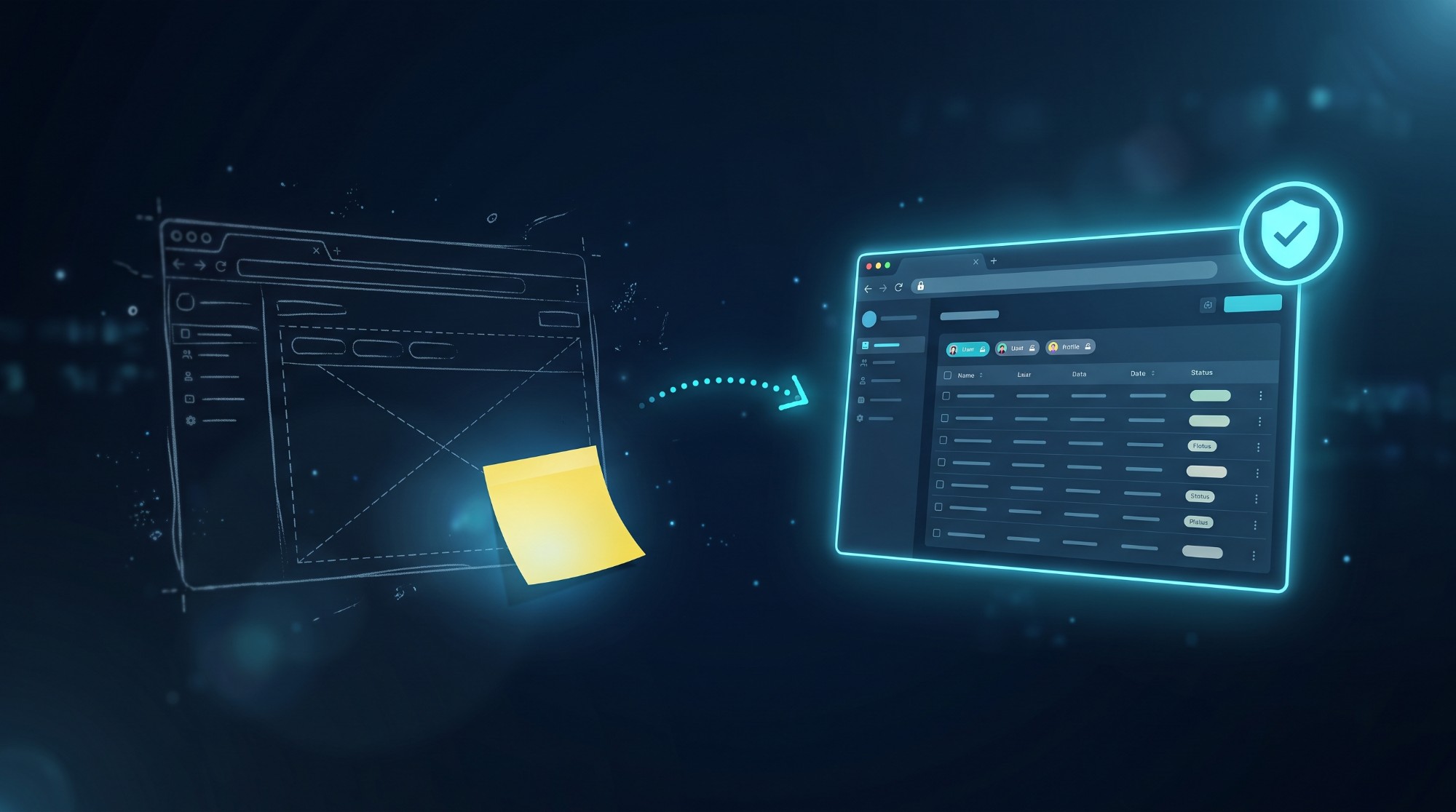
Someone in your business sat down with an AI tool and built an app. It might track jobs, calculate quotes, manage stock or chase invoices. It runs on their computer or a spare machine in the office, and it saves hours every week. That is a genuinely good result, and plenty of Australian businesses are in this position right now.
Then more people want to use it. Someone asks if they can log in from home. The data starts to matter. And someone quietly wonders what happens if the machine it lives on dies.
That is the point where a working prototype needs to become proper business software. This is what that involves.
Why a Working App Is Not the Same as a Safe One
An app that works for one person on one computer has not been tested against the things a business application has to deal with. Two people editing the same record. A staff member who should see their own jobs but not everyone's pay rates. A laptop that gets lost. A password sitting in a settings file.
AI tools are good at getting something working quickly. They are far less reliable on the unglamorous parts: security, permissions, backups and what happens when something goes wrong. Those parts are what make software safe to run a business on.
What Usually Needs to Change
Every app is different, but these are the areas we look at first.
Where the data lives. Spreadsheets, local files and single-user databases work until they don't. A proper database handles many users at once, can be backed up automatically and can be restored when something goes wrong.
Logins and permissions. Real users need real accounts, ideally tied to the Microsoft 365 sign-in your staff already use. Different roles need to see and change different things.
Security basics. Passwords and keys kept out of the code, inputs checked so they can't be abused, data encrypted when it moves and when it is stored, software kept up to date, and a record of who changed what.
Hosting. Moving from one computer or a spare in-house server to an environment that is monitored, backed up and built to stay online.
Several people at once. Making sure two people working at the same time don't overwrite each other's changes or see stale information.
Connections to your other systems. Accounting, email, calendars, and the line-of-business software the app needs to talk to.
Someone who can look after it. Code that is documented, understood and maintained, so the app doesn't depend on one person remembering how it works.
Signs It Is Time to Take the Next Step
- More than a handful of people need to use it
- People need to use it from outside the office
- It holds customer, staff or financial information
- The business would struggle if it stopped working for a day
- The person who built it is the only one who understands it
- You have been asked, or expect to be asked, how the data is protected
If two or three of those sound familiar, a review is worth doing before the app grows any further.
How We Approach It
- Review. We look at what the app does, how it is built, where the data lives and what the risks are. You get a plain-English summary of what is fine and what isn't.
- An honest recommendation. Sometimes the existing code can be tidied and secured. Sometimes it is cheaper and safer to rebuild the parts that matter properly, using what you have built as the specification. We will tell you which one makes sense, and we will tell you if you don't need us at all.
- A defined plan. Like most of our projects, the work is scoped before it starts, so you know what is being done and what it will cost.
- Build and migrate. We put the data on a proper database, add secure logins and permissions, move it to reliable hosting and move your data across without losing anything.
What Your Prototype Is Worth
The person who built it has already done the hardest part of any software project: working out what the business actually needs. A working prototype is a clear, tested description of the problem. That makes the next stage faster and less guesswork than starting from a blank page.
Common Questions
Do we have to throw away what we've built?
Not necessarily. We start by finding out what can be kept. The screens, the logic and the ideas are often worth keeping, even when the foundations underneath need replacing.
Is an AI-built app automatically insecure?
No. But it has usually not been reviewed by someone whose job is security, and the gaps tend to be in the areas the builder didn't know to ask about. A review finds them before someone else does.
What if we're not sure we need this yet?
That is a normal place to be. A conversation costs nothing, and it is much easier to plan for growth than to fix a problem after something has gone wrong.
Talk to Us About Your App
If you have built something that is now more important to your business than you expected, we would be glad to take a look. Time IT is a Newcastle-based team that builds custom software for businesses across Australia.
You can also read more about our custom software development services or how we automate manual business processes.
Back to Blog